Angular Contact Ball Bearing Supplier

Angular Contact Ball Bearing Supplier

Supports Combined Loads in High-Speed Spindles

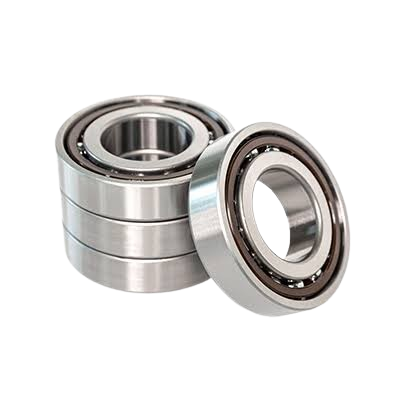
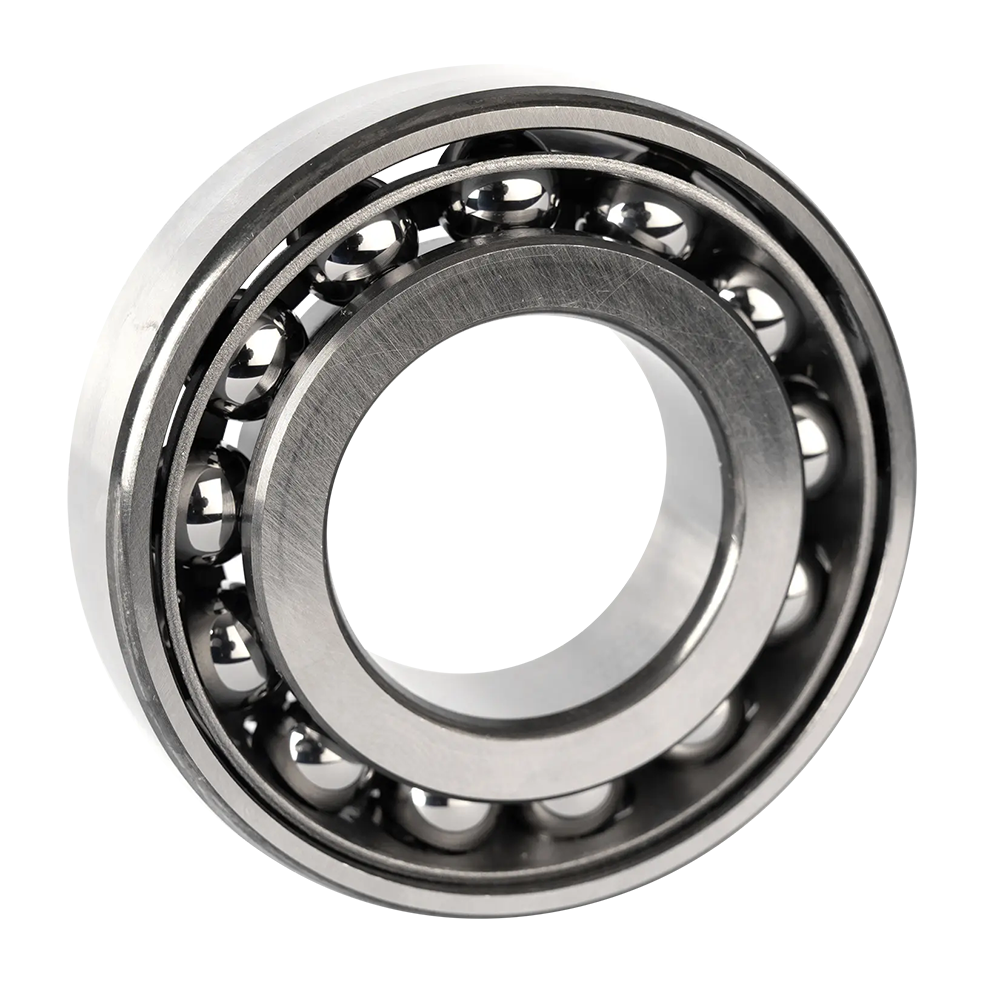
Combined load specialists. Featuring displaced inner and outer ring raceways, these bearings are designed to carry combined radial and axial loads acting simultaneously, with options for specific contact angles to optimize axial capability.

We supply premium angular contact ball bearings for high-speed precision spindles and industrial machinery. From single-row variants to matched pairs (back-to-back, face-to-face, or tandem configurations) running under preset preloads, we ensure superior stiffness and rotational accuracy.

Angular Contact Ball Bearings Category
Compact Sizing Chart

Technical Specifications & Sizing

Standard dimensional parameters for popular drawn cup and solid needle series.

Bearing Model Bore (d) Outer Dia (D) Width (B) Dynamic Load (Cr) Static Load (Cor) Limiting Speed (Grease) Limiting Speed (Oil)
7200 B 10 mm 30 mm 9 mm 5.3 kN 2.8 kN 18,000 RPM 24,000 RPM
7201 B 12 mm 32 mm 10 mm 6.8 kN 3.6 kN 17,000 RPM 22,000 RPM
7202 B 15 mm 35 mm 11 mm 8.5 kN 4.7 kN 15,000 RPM 20,000 RPM
7203 B 17 mm 40 mm 12 mm 10.4 kN 5.8 kN 13,000 RPM 18,000 RPM
7204 B 20 mm 47 mm 14 mm 14.0 kN 8.3 kN 11,000 RPM 16,000 RPM
7205 B 25 mm 52 mm 15 mm 15.6 kN 10.0 kN 9,500 RPM 14,000 RPM

* Standard 40° contact angle (B) pressed steel-caged models shown. High speed 15° (C) or 25° (A) brass/polyamide cages are available upon request.

Engineering Insights

Bearing Nomenclature & Clearance Guide

Understanding the technical suffixes, clearance prefixes, and material ratings used in industrial procurement.

Suffix & Prefix Reference

  • 7200 / 7300: Single-row angular contact ball bearings designed for high radial and single-direction axial loads.
  • 3200 / 3300: Double-row angular contact ball bearings designed to support bidirectional axial loads in a compact layout.
  • A / B / C: Contact angle classifications: 15° (C), 25° (A), or 40° (B) defining axial vs. radial load capabilities.
  • DB / DF / DT: Paired mounting arrangements: Back-to-Back (DB), Face-to-Face (DF), or Tandem (DT).

Clearance & Housing Fits

  • Preload (EL/L/M/S): Controlled internal axial clearance preset for high stiffness and radial accuracy.
  • Back-to-Back (DB): Arranged so load lines diverge, providing high stiffness against tilting moments.
  • j6 / k6 Fit: Recommended shaft fits to guarantee proper seating and retain preload setup.
  • JS6 / H6 Fit: Recommended housing tolerances to ensure smooth axial slide movements under thermal expansions.
Technical Guide

Bearing Selection & Sizing Guide

Critical engineering parameters, structure details, and operating limits to help you select the ideal component.

Combined Load Capacity

Uniquely designed inner and outer ring displaced raceways accommodate heavy combined radial and axial thrust loads acting simultaneously.

Paired Configurations

Typically mounted in paired structures (back-to-back, face-to-face) to provide high system rigidity and withstand bidirectional thrust movements.

High Speed Limits

Lower rolling friction coefficients than roller bearings allow them to achieve very high RPM limits, ideal for precise high-speed lathe/grinding spindles.

Target Environments

Common Industrial Applications

These bearings are engineered to deliver reliable rotation and support critical equipment in harsh sectors, including:

Machine Spindles

Secures high-speed mechanical lathe spindles against vibration and deflection, ensuring micrometer precision.

Fluid Pumps

Supports oscillating rocker arm pivots inside high-RPM internal combustion engines.

Traction Motors

Sustains high pressures inside gear pumps and compact axial piston pumps.

Power Tools

Fits inside the tight gear housings of hand drills, angle grinders, and chainsaws.

Need Sizing Support?

Get an Instant Quote on Angular Contact Ball Bearings

Contact our technical sales team for model compatibility audits, clearance estimates, and volume pricing discounts.

Submit Inquiry Now
FAQ

Frequently Asked Questions

Technical details, selection parameters, and service queries resolved by our engineering sales team.

They feature inner and outer ring raceways that are displaced relative to each other in the direction of the bearing axis. This design allows them to support combined radial and axial loads.
Since single-row angular contact bearings can only support axial forces in a single direction, they are paired (back-to-back, face-to-face, or tandem) to handle bidirectional forces.
The contact angle (typically 15°, 25°, or 40°) determines the bearing's load capacity. A larger angle supports higher axial thrust loads but reduces limiting speed capacity.